Book recommendations, reviews, and reading lists.

ACOTAR Is Not Porn (And That Says More About You Than the Books)
2026-03-23 · Written by Josh
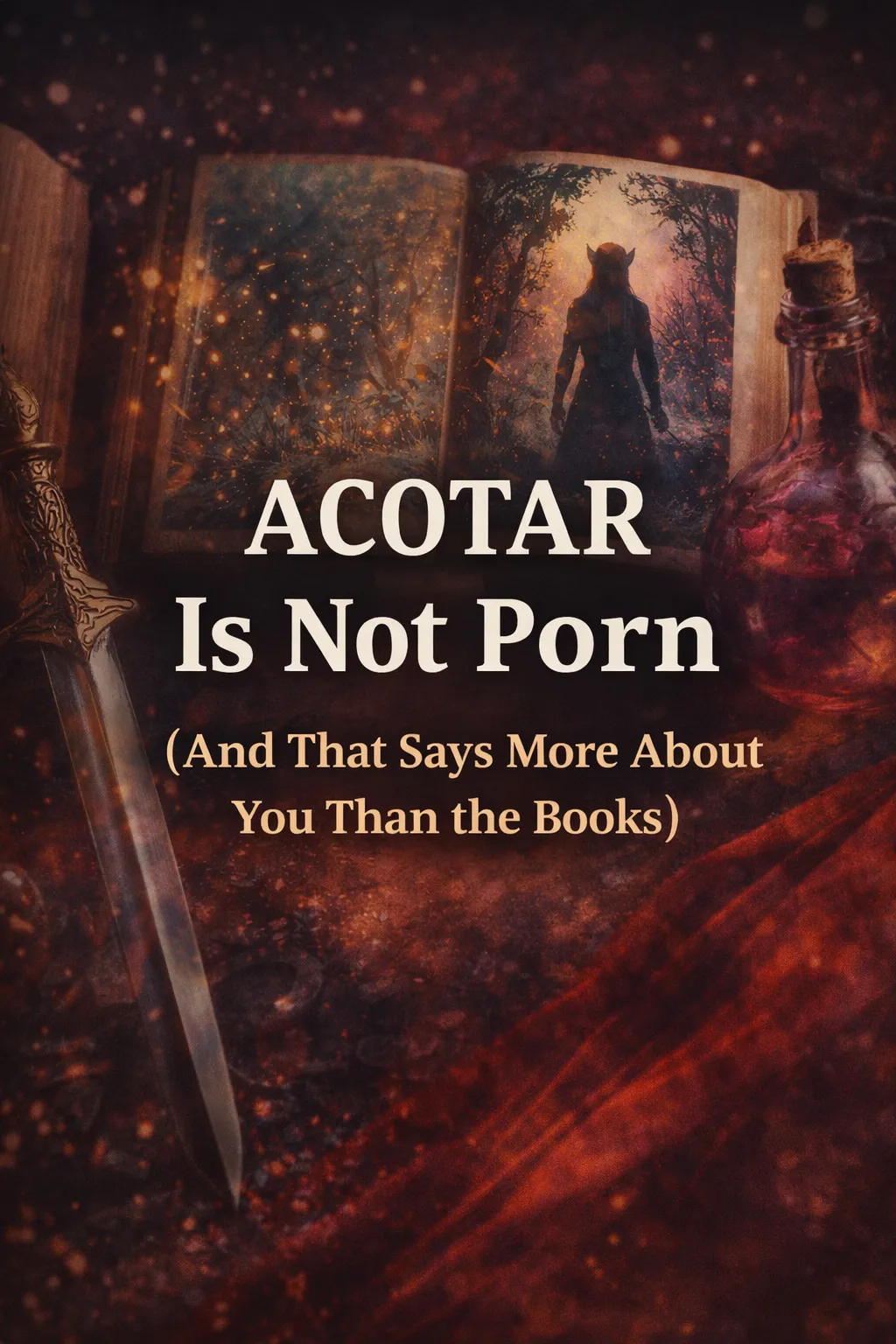
"My Wife's Reading Fairy Porn Again"
I've been watching this play out for years. Someone finds out you're reading A Court of Thorns and Roses — or Fourth Wing, or really any fantasy romance published in the last decade — and they get a look. You know the look. Then comes the label: fairy porn, dragon porn, smut, occasionally the more diplomatic spicy.
The label is wrong. Not as a matter of taste, but as a matter of basic description. The spice-to-plot ratio in ACOTAR is low. Not modest, not tasteful-but-present — genuinely low, in the way that a drama with one sex scene isn't classified as adult entertainment. Readers who've actually read erotica find this comparison almost comically off-base. The people who haven't tend to be the ones saying it loudest.
What's interesting isn't the mislabeling. People mislabel things all the time. What's interesting is why this particular mislabeling sticks, who it comes from, and what it does to the people it lands on.
The Spice Level Is Not What They Think It Is
Here is ACOTAR's actual situation: it's a multi-book fantasy series about fae politics, a war, and a woman navigating power she didn't ask for. There are romantic subplots. There are, in later books, scenes that go further than a closed door. But the series is predominantly — overwhelmingly — plot. Magic systems. World-building. Political maneuvering. Character arcs that span thousands of pages.
Fourth Wing gets called "dragon porn" by people who have apparently not counted the scenes. Two. There are two such scenes in the first book. Game of Thrones has more per episode, and nobody calls it pornography (almost nobody). A Song of Ice and Fire — the source material for that show — has substantially more explicit content than anything Sarah J. Maas has written. No one who recommends it to someone brings that up as the defining characteristic.
This is not a coincidence. The mislabeling isn't based on content. It's based on audience.
Who's Actually Doing This
The "fairy porn" label spreads through two channels, and they operate in opposite directions.
The first is readers themselves. Romantasy fandom uses the term spicy partly as a genuine descriptor and partly as an inside joke — a way of flagging that a book goes further than, say, a Regency-era headband-and-gloves courtship. The community understands what it means. The problem is that when outsiders hear this self-deprecating joke, they take it literally. The wink-and-nudge becomes the headline.
The second channel is everyone who has never read any of this and is forming opinions based on cover art and vibes. Fantasy romance covers are often elaborate, sometimes shirtless, frequently saturated with color in ways that signal "this is not literary fiction." That signal, combined with the word romance, does a lot of work before a single page is opened. The conclusion arrives before the evidence.
The result is a genre that gets described almost entirely by people who have not read it.
What It Reveals About the People Saying It
There's a specific profile that emerges from these conversations. The people most confident that ACOTAR is pornographic are usually people who have no meaningful experience with either erotica or fantasy fiction. They haven't read actual erotica so they have no calibration point. They haven't read complex secondary-world fantasy, so the political intrigue and magical systems read as dressing rather than substance. What they're left with is: there's romance, it's clearly not serious literature, therefore it must be smut.
This is a category error born of limited exposure. A reader who came up on fanfiction — where the community invented specific content-rating systems because they had to, because the actual range of content runs from G to genuinely explicit — would find ACOTAR unremarkable. Not mild in a bad way, just normal-to-mild for a genre that knows what it's doing. The horror that some readers express about ACOTAR is a precise measure of how little fiction they've consumed with any romantic content at all. There's nothing wrong with that, but it shouldn't be mistaken for a reliable cultural data point.
There was a real moment — discussed enough online to count as a data point — where readers were reportedly scandalized that the love interest in The Cruel Prince had a tail. A tail. In a fae fantasy novel. If that's where someone's threshold sits, they are not calibrated to assess what is and isn't explicit. They're calibrated to anything that isn't totally sanitized.
The Gendered Mechanics of the Dismissal
I want to be careful here not to retread ground I've already covered in why dark romance readers aren't bad feminists, because the core argument is there and doesn't need repeating. But there's something specific happening with the "fairy porn" dismissal that goes beyond the general feminist critique.
The pornographic label specifically removes women's reading from the category of legitimate fiction. It's not just this isn't to my taste or this isn't serious literature — it's this is obscene material dressed up as a book. That framing does something neat: it makes the reader complicit in something embarrassing, and it makes anyone who defends the books seem like they're defending pornography rather than fantasy novels.
The people I've seen deploy this label most confidently are often men who'd have no equivalent hesitation about recommending crime fiction with significant violence, or thrillers with morally bankrupt protagonists, or literary fiction that wallows in its own bleakness. The content those books contain isn't reflexively dismissed as pornographic. Because the content those books contain is aimed at people like them, and the content in ACOTAR is aimed at women.
Women's genre fiction — romance especially, but fantasy romance doubly — gets evaluated on a standard that doesn't apply anywhere else. The presence of desire, of emotional stakes, of relationships driving plot rather than action, gets read as a kind of embarrassment. The label porn is just the sharpest version of a broader dismissal: this isn't real reading.
The Deterrent Effect
Here's the part that bothers me most practically: the label actually works. People who might have enjoyed these books don't pick them up because someone who didn't read them told them it was pornography.
This matters because the readers who get deterred are often people who would have genuinely loved what they missed. Someone who likes complex world-building and political maneuvering but steers away from ACOTAR because of its reputation is leaving a lot of what they want on the table. The romantic content is there, but it's not what the series is built on, and it's not what most readers remember most about it.
The label narrows the audience down to people already comfortable ignoring the stigma — which tends to mean people already embedded in romantasy fandom. Everyone on the margins, everyone who was curious but cautious, everyone who might have come in through the plot rather than the romance — they stay out. The genre loses readers it didn't need to lose, and those readers miss something they might have loved.
That's the real cost of a mislabeling campaign run by people who haven't read the books.
The Marketing Complication
There's a layer to this that's worth acknowledging: SJM's publisher originally marketed some of these books as YA. Not because they were YA — they weren't, and the publisher knew it — but because the YA marketing machine was reliable and profitable and the books fit certain genre signals. When the content eventually didn't match the YA label, some of the backlash attached to that gap. The this doesn't belong where it was placed frustration got translated into the content is inappropriate, which is a different claim.
The publishing industry created some of this problem. That doesn't excuse the people running with the "porn" label — they're making a content claim, not a shelving complaint — but it explains some of the origin of the confusion.
It also explains why fans of these books sometimes use spicy as a winking self-label. If the publisher tried to frame it as YA and it clearly wasn't, using spicy is a way of saying yes, I know, we all know, it's fine. It's an in-group signal that got exfiltrated and weaponized by people who didn't know what they were hearing.
What This Means for Romantasy Going Forward
The genre is growing. The readership is growing. The cultural footprint is growing — in ways that make the "fairy porn" label harder to sustain, because eventually enough people will have actually read these books to outvote the people who haven't.
But in the meantime, the mislabeling does real work. It shapes which books get serious review coverage and which don't. It shapes who feels comfortable saying publicly that they read them. It shapes the assumptions that teachers, librarians, and recommendation algorithms apply to the genre. It makes the defensiveness inside romantasy fandom a little more understandable — when the external conversation about your reading is dominated by people who don't read it, defensiveness is a reasonable response.
I'm not asking anyone to love ACOTAR. I have opinions about where it works and where it doesn't, and they're not universally positive. But "this has some explicit content in later books" and "this is pornography" are not the same statement. One describes the reading experience accurately. The other tells me the speaker formed their conclusion before they opened the cover.
The husband who got handed two books and discovered his wife was reading fantasy with romantic subplots — not pornography — represents exactly what changes minds on this. Not argument, not defense of the genre, just reading. It turns out the books say more about themselves than the label ever could.
If someone has told you that ACOTAR is smut and you haven't read it, consider the source. Ask them when they finished it. The answer will tell you everything you need to know about how seriously to take the opinion.
Continue Reading
Why Readers Hate Historical Fiction About Real People
Historical fiction is one of the most beloved genres in publishing. It's also one of the most contentious, and the fault line runs right through real people's graves.
Reading Dark Romance Doesn't Make You a Bad Feminist
The argument that dark romance is anti-feminist says more about who we trust to handle fiction than it does about the books themselves.