Book recommendations, reviews, and reading lists.

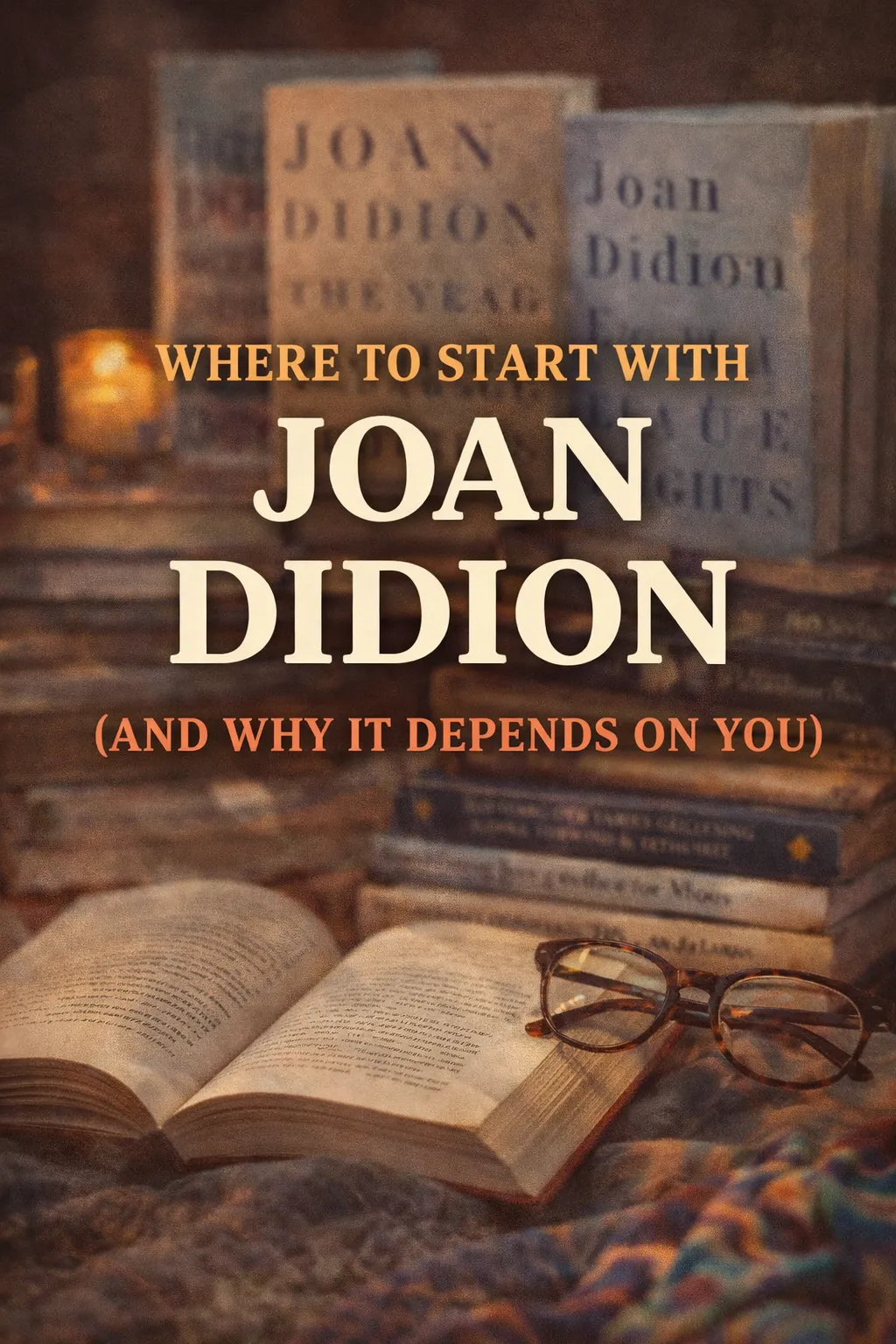
Where to Start With Joan Didion (And Why It Depends on You)
2026-03-23 · Written by Josh
She's Several Writers in One
Joan Didion spent six decades writing, and the person who wrote Slouching Towards Bethlehem in 1968 is not the same person who wrote The Year of Magical Thinking in 2005. Her cool, precise, slightly unsettled voice stayed but the subject matter moved from California counterculture to personal catastrophe to California history to the machinery of American politics. That range is part of why she matters and also why the question "where do I start with Didion?" doesn't have a single right answer.
What I can tell you is that there are really three versions of Didion, and which one you encounter first will shape how you think about her. Getting that first book right matters more than it does for most authors, because Didion requires a certain kind of attention. She rewards readers who come in ready to meet her on her own terms. The wrong entry point and you might close the book after fifty pages thinking you don't get it. For example, I closed The Year of Magical Thinking because within 50 pages I knew that I would need it one day and wanted to save it for when I needed it. If you've read the book you know what I mean. It would be a shame, because there's a version of Didion that exists specifically for where you are.
If You Want to Understand What All the Fuss Is About
Start with Slouching Towards Bethlehem.
This is her most famous work and, for most readers, her most immediately arresting. It's a collection of essays written in the late 1960s, and the title essay — a piece of journalism about Haight-Ashbury during the Summer of Love — is still one of the most technically impressive things I've read in nonfiction. Didion drops you into the center of a cultural moment and makes you feel both inside it and watching it dissolve at the same time. She is present on the page in a way that feels uncomfortably close, and yet she maintains a distance that you can't quite locate.
The rest of the collection spreads outward from California into film stars, water politics, and the specific texture of anxiety that ran through late-1960s America. Reading it now, decades removed, you still feel transported — not in a nostalgic way, but in the way of suddenly seeing the world through someone else's eyes and realizing those eyes catch things yours don't.
If you want to know what makes Didion Didion — the choppy sentences, the repetition used as pressure, the sense that reality is slightly coming apart at the seams — this is the book that shows you. The craft is visible enough that you can study it, and the subject matter is vivid enough that you don't want to.
If You're Going Through Something
Read The Year of Magical Thinking when you're ready for it.
This is not a book to approach casually. It's the account of the year following her husband's sudden death, written while her daughter was still critically ill. Didion approaches grief analytically. It reads like she is trying to hold herself together through the act of writing. The result is a witness to grief not a solution to it.
I'd call it brave, but that word has been worn down by overuse. What I'll say instead is that it does something very few grief memoirs manage: it makes the irrationality of grief feel logical. The "magical thinking" of the title refers to the way the grieving mind negotiates with reality, finding ways to keep one foot in a world where the person might still come back. Didion doesn't pathologize this. She documents it clearly, without embarrassment, and that clarity is what makes the book land.
It's not a book to recommend to someone who hasn't lost anyone significant. That is why I DNF'd it and my commentary on it is from research and other people's experiences. I am blessed in a way that makes me ignorant of the loss that this book represents. When the time comes (hopefully never) it will be there waiting for me on my bookshelf. If that's where you are, or where you've been, this book will mean something different to you than it will to a reader coming at it as literature only.
Come to Slouching Towards Bethlehem first if you want her craft. Come to The Year of Magical Thinking when you need something that understands the thing you're carrying.
If You Love Literary Fiction and Want to See What She Could Do With a Novel
Try Play It as It Lays.
This is her most celebrated novel, and it works by compression. Where most novelists sprawl, Didion contracts. The chapters are sometimes a page, sometimes a paragraph. The prose is stripped down to the point where you feel like you're reading a screenplay that forgot to add the stage directions. Her protagonist, Maria Wyeth, moves through Hollywood and the Nevada desert in a kind of ambulatory dissociation, and Didion uses that drift to say something about what it costs to be a woman in that particular world at that particular time.
The comparison that stuck with me — and that I've heard others reach for — is to Dashiell Hammett. The sentences are funneled and condensed, every word doing more than one thing. There's very little softness in the book. It asks you to pay attention at the sentence level, not because Didion is being obscure but because she's doing the work of a poet inside the frame of a novel.
This is where I'd send a reader who's already comfortable with literary fiction that demands something back. If you want story momentum, this might frustrate you. If you want to see how far spare prose can be pushed before it cracks, it will genuinely surprise you.
If You're From California (or Trying to Understand It)
Where I Was From is the one.
This is probably the least-read of her major books and one I think is undervalued. It's part memoir, part cultural history, and part takedown of the myths California tells about itself — about pioneers and self-reliance and the frontier spirit, and how those myths have always papered over something more complicated and less flattering.
I find it most resonant for readers with a California connection — people who grew up with those myths fed to them and have spent time trying to figure out what to do with them. But it's also useful as a piece of thinking about how places construct identities for themselves, how families transmit those constructions across generations, and how a writer processes the place that made her.
If you came to Didion through Slouching Towards Bethlehem and wanted more of her thinking about California as a subject rather than just a backdrop, this is the book that completes that thought.
A Note on The White Album
Her second essay collection sits just slightly behind Slouching Towards Bethlehem in the conversation, but I'd argue it's actually the better entry point for readers who prefer their essays formally self-aware. The title essay opens with one of the most quoted lines in American nonfiction
"We tell ourselves stories in order to live"
and then spends forty pages interrogating what happens when the stories stop working.
The collection covers the late 1960s and 1970s, which means it overlaps in era with Slouching, but the angle is different. Less reportage, more analysis. If Slouching shows Didion inside a cultural moment, The White Album shows her trying to make sense of what it meant afterward.
I'd start with Slouching but if you finish that and want more of the same register, the next stop is obvious.
On the Documentary
Multiple readers recommend the Netflix documentary The Center Will Not Hold, directed by her nephew Griffin Dunne. It's a good companion to the books, particularly if you've read The Year of Magical Thinking and want context for who she was before that decade of loss. I'd watch it after at least one of the books rather than before — the books should be the primary experience, and the documentary works better when you already have her voice in your head.
The Honest Recommendation
If you want a single place to start: Slouching Towards Bethlehem. It's the book that most fully captures what makes her singular, it's accessible without being easy, and it's the one most likely to make you want to read everything else she wrote.
But the longer I spend with her work, the more I think the right entry point is situational. The Year of Magical Thinking is one of those books where timing is almost everything. I'm choosing to read it when I've experienced something similar. Play It as It Lays rewards a reader who's been primed by her essays to trust her prose instincts. Where I Was From means more if you bring something personal to it.
Didion herself wrote that we tell ourselves stories in order to live. What she didn't say — but what her body of work demonstrates — is that the stories we need change depending on where we are. Pick the book that matches where you are. You can work back to the others from there.
Have you read Didion? I'm always curious which book people started with and whether it was the right one for them.
Continue Reading
12 Books Like James by Percival Everett
If James by Percival Everett left you wanting more, these books deliver the same brilliance — reimagined classics, radical perspectives, and prose that doesn't let go.
The 10 Most Recommended Authors on Reddit, According to 2,600+ Book Threads
I analyzed over 2,600 Reddit threads about books and ranked the authors readers actually push people toward. The results are surprising and not what any best-of list would predict.