Book recommendations, reviews, and reading lists.

Why Reading Multiple Books at Once Is Actually Better
2026-03-18 · Written by Josh
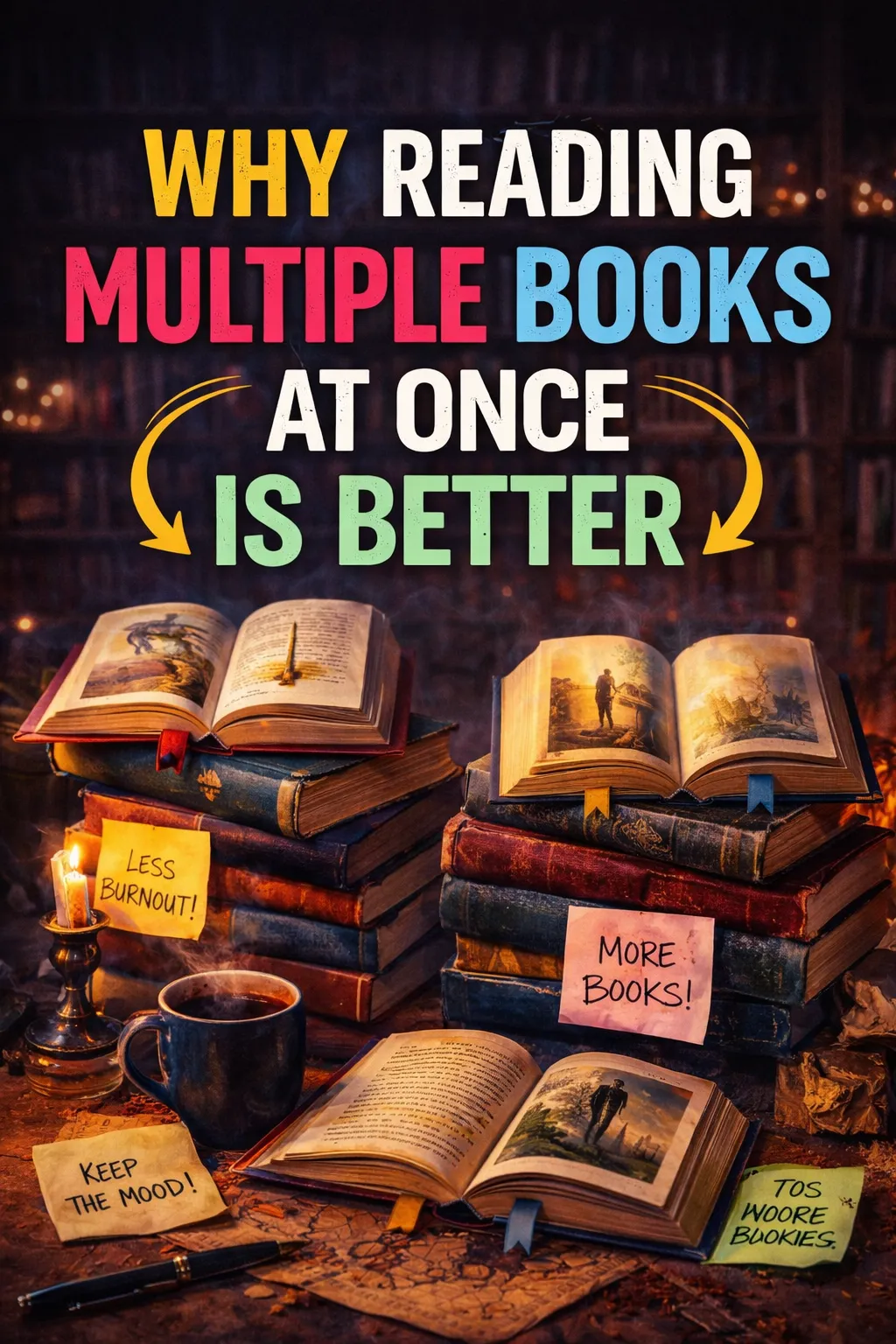
The Guilt of the Open Book
I have a confession. Right now, as I write this, I have four books going. A novel on my nightstand, a nonfiction book on my desk, an audiobook in my car, and a short story collection that lives wherever I last sat down. If you'd told twenty-year-old me that this was a legitimate way to read, I would have felt a lot less guilty about the state of my bookshelf.
For a long time, I thought reading multiple books at once meant I lacked discipline. I'd start something, get restless, pick up something else, and then beat myself up about it. Somewhere along the way I'd internalized this idea that "real readers" finish one book before starting another, that parallel reading was a sign of a scattered mind rather than a curious one.
I was wrong. And I think a lot of readers are carrying around that same unnecessary guilt.
The Case for One Book at a Time
Let me be fair to the other side, because it's not a bad argument.
Reading one book at a time means you're fully immersed. You don't have to remember which character belongs to which story. You don't accidentally mix up plot threads. You give the author your undivided attention, which is arguably what they deserve — they spent years writing this thing, the least you can do is not wander off halfway through.
There's also the satisfaction of momentum. When you're locked into a single book, you build speed. The characters become familiar, the prose settles into your brain, and you hit that beautiful point around page 150 where the book starts reading itself. Splitting your attention between three novels means you might never hit that flow state with any of them.
I get it. And for certain books — dense literary fiction, intricate mysteries, anything with a cast of forty characters — yeah, maybe give it your full focus. I'm not going to pretend I could juggle War and Peace alongside two other novels and keep everyone's patronymic straight.
But here's the thing: most of us aren't reading War and Peace.
Why Multiple Books Actually Works
The single biggest advantage of reading multiple books at once is dead simple: you always have the right book for the moment.
Think about it. You don't eat the same food at every meal. You don't listen to the same genre of music all day. Your mood shifts, your energy level changes, and the reading experience you want at 7 AM with coffee is different from what you want at 11 PM when you're half-asleep.
When you have one book going and it's a dense 600-page historical epic, you're not reaching for it during a fifteen-minute lunch break. You're reaching for your phone. But if you also have a breezy essay collection or a fast-paced thriller on deck? You're reading instead of scrolling. That's not a lack of focus. That's strategy.
I started naturally sorting my books by context. One commute-friendly book — something I can pick up and put down without losing the thread. One book for longer reading sessions, usually fiction that rewards sustained attention. And sometimes an audiobook for walks or chores, which doesn't even compete with the others because it occupies a completely different part of my day.
The result? I read more. Not because I'm forcing myself, but because I've removed the friction. There's always something that fits the moment.
The Format Trick Nobody Talks About
Here's something that changed the game for me: treating different formats as different reading slots.
A physical book, an ebook, and an audiobook aren't really competing with each other. They occupy different spaces in your life. The physical book lives on the nightstand. The ebook is on your phone for waiting rooms and lines. The audiobook plays during your commute or while you're cooking.
Once I stopped thinking of these as "three books I'm reading simultaneously" and started thinking of them as "three different reading contexts," the guilt evaporated. I'm not abandoning any of them. I'm just reading each one in its natural habitat.
This is especially useful if you read both fiction and nonfiction. I find that nonfiction works brilliantly as a morning read — my brain is fresh, I'm actually retaining information, and chapters tend to be self-contained enough that I can read one and feel satisfied. Fiction is better at night when I want to sink into a story. Mixing the two doesn't create confusion because they're occupying completely different mental spaces.
"But I'll Forget What's Happening"
This is the fear that keeps people reading one book at a time, and I think it's mostly a myth.
You watch multiple TV shows at once, right? You're following three or four or eight different series with different characters, different plotlines, different worlds, and you don't mix them up. Nobody sits down for an episode of a cooking competition and thinks they're watching a crime drama. Your brain is much better at compartmentalizing narratives than you give it credit for.
The trick is genre separation. If you're reading two dark thrillers with unreliable narrators at the same time, sure, you might start blending them together. But a thriller, a memoir, and a fantasy novel? Those are different enough that your brain files them in separate folders automatically.
I've found my actual limit is about three or four books at a time. Beyond that, some of them start collecting dust, and I'm just pretending I'm "reading" them when really they're sitting there accusingly. Some people genuinely read ten-plus books simultaneously. I admire those people the way I admire ultramarathon runners — with deep respect and zero desire to join them.
The Real Enemy Isn't Multiple Books
Here's what I think is actually going on when people worry about reading too many books at once: they're confusing parallel reading with not finishing books.
Those are two different problems.
If you're starting twelve books and finishing none of them, the issue isn't that you're reading too many — it's that you might be picking books you're not that into. Or you're a completionist who won't abandon a book that isn't working, so it sits there blocking your reading pipeline like a clogged drain.
Give yourself permission to quit books. Seriously. Life is short, and there are more books published every day than any human could read in a lifetime. If you're a hundred pages in and you don't care what happens next, put it down. That's not failure. That's curation.
Once I started quitting books guilt-free, my parallel reading problem solved itself. The books I keep going are the ones I actually want to read. And wanting to read something — surprise — makes you read it.
The Mood Reader's Advantage
There's a type of reader called a "mood reader," and I think we've been unfairly maligned. A mood reader picks up whatever they're in the mood for, which means they don't follow reading schedules or neat little one-at-a-time queues. They grab what calls to them in the moment.
This drives some people insane. TBR lists? Useless. Reading challenges? A joke. Your carefully curated stack of "what I'm reading next"? Decorative, at best.
But mood readers have a superpower: they almost never force themselves through a book they're not enjoying. Every reading session is driven by genuine interest. And genuine interest is the single best predictor of whether you'll actually retain and enjoy what you read.
I've tried the disciplined approach. I've made the lists, set the schedules, committed to one book at a time. And you know what happened? I read less. Because when the scheduled book didn't match my mood, I'd put off reading entirely. I'd choose Netflix instead. The structure that was supposed to help me read more was actually a barrier.
Now I keep a rotating cast of three or four books, grab whichever one matches the moment, and I'm reading more than I ever did when I was trying to be disciplined about it.
Finding What Works
I don't think there's a universally correct way to read. Some people thrive with one book at a time, and they finish sixty books a year doing it that way. That's great. It would make me miserable, but it's great.
What I do think is that a lot of people are parallel readers who've been told they're doing it wrong. They feel guilty about the three bookmarks sticking out of three different books on their nightstand. They think they need to fix something about their reading habits when the real fix is just... accepting how they work.
If you've always bounced between books, stop fighting it. Lean into it. Separate your books by format, by genre, by time of day. Give yourself permission to not finish things. Keep your active list to a manageable number — whatever that means for you.
And the next time someone asks you how many books you're reading right now, don't apologize for the answer. You're not scattered. You're just a reader with range.
Continue Reading
ACOTAR Is Not Porn (And That Says More About You Than the Books)
Calling ACOTAR "fairy porn" reveals a specific kind of cultural illiteracy — and the people spreading the label are often the ones who've never read it.
Why Readers Are Breaking Up With Favorite Authors
Sometimes you don't stop reading an author because something went wrong. You stop because you changed, or they did, or you finally noticed something that was there all along.