Book recommendations, reviews, and reading lists.

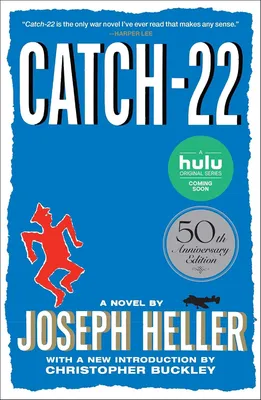
Catch 22
by Joseph Heller
| Published | 2011-04-26 |
| ISBN | 9781436152198 |
What Readers Say
Readers consistently describe Catch-22 as one of those books that delivers a one-of-a-kind reading experience — and then haunts you precisely because you know you can never recapture it. One reader put it bluntly: "This is one of those books that I loved so much that I don't want to read it again because I know I will never get that feeling again." That's a particular kind of compliment, the kind you give something irreplaceable.
The central appeal, according to readers, is the feeling of being the only sane person in an insane system. One person described it as "kinda like being the only sane person in a room full of insane people, but since you're not like everyone else, you are the crazy one" — and called it their favorite book. That paradox is what makes the novel stick. It's not just funny. It's philosophically uncomfortable.
There's also consistent surprise at how it lands emotionally. Many readers come in expecting absurdist comedy and leave thinking about war, mortality, and institutional power in ways they didn't anticipate. One reader paired it with All Quiet on the Western Front back-to-back and described becoming "a devout pacifist" — which says a lot about how much weight the book carries beneath its circular logic and dark jokes.
One interesting debate in the Reddit threads: whether Catch-22 is absurdist in the philosophical sense. The answer most readers land on is no — the final chapters push back hard against meaninglessness and argue for individual life and morality mattering, which runs counter to true absurdism. It uses absurdist style to make a deeply humanist argument.
Who It's For
This is a book for readers who are frustrated by systems — bureaucracies, institutions, rules that exist only to perpetuate themselves. If you've ever felt like the one sane person watching everyone else operate by incomprehensible logic, Catch-22 will feel like someone finally put your experience into words. It's also a strong fit for people drawn to dark comedy with genuine moral weight.
It consistently gets recommended alongside Slaughterhouse-Five by Kurt Vonnegut — arguably the closest companion read, another darkly comic anti-war novel from the same era. All Quiet on the Western Front pairs naturally with it too, especially for readers who want to feel the full emotional arc from brutal realism to bitter satire.
Readers also recommend it to people looking for readable classics — it comes up explicitly as one of the "instantly readable" classics rather than the slog-through-it variety. If you bounced off Ulysses or Blood Meridian, Catch-22 is the kind of canonical novel that actually rewards you for showing up.
Reading Context
No translation issues — this is an English-language novel. The main practical note I'd offer is about pacing expectations: the book is deliberately circular and repetitive, and that's the point. Scenes loop back. Characters reappear. Time isn't linear. A few readers note this can feel disorienting at first, but pushing through is worth it — the structure mirrors the bureaucratic trap the protagonist can't escape.
There's also a sequel, Closing Time, published in 1994, though it's rarely mentioned and not considered essential. Most readers treat Catch-22 as a standalone.
Content-wise: the novel contains war violence, death, and some sexual content. None of it is graphic in a horror sense, but it's not a sanitized book. Several readers mention having read it young and loved it, then reread it as adults and found new layers. That's probably the best case scenario: read it once when you're young and frustrated, and again when you're old enough to know the frustration never really goes away.