Book recommendations, reviews, and reading lists.

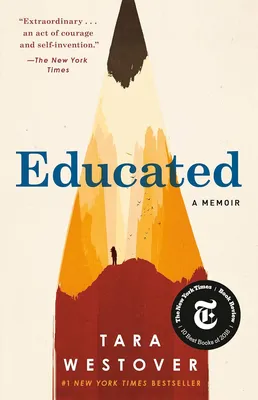
Educated
by Tara Westover
| Publisher | Random House |
| Published | 2018-02-20 |
| Pages | 353 |
| ISBN | 9780399590504 |
| Categories | Biography & Autobiography |
What Readers Say
Readers consistently describe Educated as the kind of book that erases the boundary between memoir and fiction—not because it feels invented, but because Westover's story is so propulsive and immersive that people forget they're reading something true. I see this in how many readers mention getting "through a chapter or two before realizing it was a memoir," and how often it lands on lists of non-fiction books people simply couldn't put down. The sheer pace of the narrative, combined with Westover's refusal to sensationalize or self-pity, creates something that feels urgent rather than ponderous.
What readers seem to appreciate most is the book's unexpected emotional architecture. Multiple commenters point out that Westover finds happiness without romantic love being the engine of her ending—one reader calls this a "bingo" for anyone seeking a female protagonist whose fulfillment doesn't hinge on a partner. The praise extends to how she navigates the impossible tangle of loyalty and self-preservation within her family. The trauma is real, but so is the ambivalence. I notice readers often mention empathizing with Westover's mother in ways that surprised them, even while recoiling from the father's extremism, which speaks to how carefully the relationships are rendered.
The book doesn't attract much structural criticism in these discussions—when mentioned, it's almost always with reverence. The closest thing to a critique I can find isn't about Westover at all, but from a reader comparing Educated to Mary Karr's The Liars' Club and Jeanette Walls's The Glass Castle, noting they read all three concurrently and found themselves struggling more with Karr's mother than Westover's. This triangulation suggests something about Westover's restraint: readers feel she earns their empathy for her family even when those same family members cause enormous harm.
Who It's For
This is for readers who loved The Glass Castle and want something that does the same thing to their understanding of family loyalty and self-invention—the two books are almost always mentioned together, like siblings in the memoir canon. It's also for anyone who appreciates non-fiction that reads with the momentum of a novel; if you've been gripped by Patrick Radden Keefe's Say Nothing or Joan Didion's The Year of Magical Thinking, Westover operates in similar territory where the prose itself keeps you turning pages. Beyond that, I'd recommend this specifically to people seeking narratives about women who build lives on their own terms. One reader explicitly flagged it as a book where "romantic love has little if nothing to do with" the protagonist's happiness, and Westover's arc—from isolated survivalist childhood to a Cambridge PhD—is fundamentally a story about education as both escape and identity, not about being saved by a partner.
Reading Context
Educated sits at the center of a specific modern memoir cluster: readers almost reflexively pair it with The Glass Castle by Jeannette Walls and The Liars' Club by Mary Karr, three books that examine chaotic, neglectful, or abusive upbringings through the lens of a daughter's clear-eyed recollection. If you're building a reading stack, those three together create a powerful conversation about how different writers metabolize similar material. The book also appears regularly alongside narrative non-fiction that crosses into true crime or cultural history—Killers of the Flower Moon, Say Nothing, Unbroken—suggesting Educated appeals to readers who want truth delivered with the tension and pacing of fiction. One thing to know before starting: the book contains graphic depictions of physical injury and domestic violence, and Westover doesn't soften the edges for comfort. There's no film adaptation, though given its cultural footprint, that feels more like a matter of time than an impossibility.