Book recommendations, reviews, and reading lists.

Hyperion
by Dan Simmons
| Publisher | Spectra |
| Published | 2011-01-12 |
| Pages | 532 |
| ISBN | 9780307781888 |
| Categories | Fiction |
| Google Rating | 5.0/5 (1 ratings) |
What Readers Say
There's a real split in how people talk about Hyperion online, and I find it more interesting than the usual pile-on of praise. On one side you have people who call it their all-time favorite sci-fi novel — a "masterpiece," a "GOAT," something they reread every year. One commenter put it simply: "Hyperion kicked the door open for me." Another said they could list only seven sci-fi books they'd want for the rest of their life, and Hyperion and The Fall of Hyperion (as one story, split by the publisher) were on it. It shows up constantly in "best sci-fi ever" threads right alongside Dune and Foundation, the kind of company that means something.
On the other side, you have readers who bounced off it hard. The Canterbury Tales structure — seven pilgrims, each telling their story — is a genuine dividing line. One person said they hated the book for the same reason they hate Chaucer, then picked up the second book anyway and loved it. Another couldn't get past the first chapter. A commenter on r/printSF described the Cantos as "nothing makes sense until the second book," which is either a warning or a promise depending on your patience level. One reader put it bluntly: "I kept wishing the characters would stop talking." Dan Simmons being wordy is mentioned more than once, though the people who love the book seem to find that intelligence immersive rather than exhausting.
The series split also comes up constantly. Most readers treat Book 1 and The Fall of Hyperion as one novel (they were originally meant to be). Books 3 and 4 (Endymion, The Rise of Endymion) get a more complicated reception — one commenter described them as feeling like "sequels written after the original author has died," a shift in tone and structure so pronounced it reads like a different series. That said, plenty of readers enjoyed all four.
Who It's For
Hyperion is for readers who want scope — literary allusions, philosophical weight, multiple genre modes in a single book, and a monster (the Shrike) that genuinely unsettles people. It gets recommended alongside Dune, A Canticle for Leibowitz, The Dispossessed, and A Fire Upon the Deep — books that reward patience and treat ideas seriously. If you're the kind of reader who finished Project Hail Mary and wanted something with bigger ambitions and a longer shadow, this is the obvious next step.
It is not a good entry point for people new to sci-fi. Reddit commenters explicitly flag it as inaccessible and suggest Murderbot or The Expanse first. It also gets recommended to horror readers — Dan Simmons was primarily a horror writer before this, and the Shrike storyline and the individual pilgrim tales carry genuine dread. If you liked The Terror or Carrion Comfort and want to see what Simmons does with space opera, this is where you go.
Reading Context
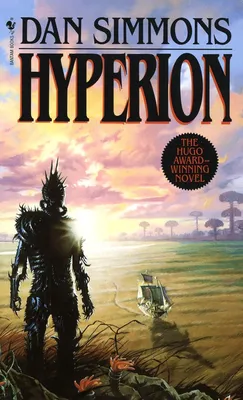
Hyperion (1989) won the Hugo Award and is the first book in the four-volume Hyperion Cantos. The structure really is Canterbury Tales in space — seven pilgrims travel to the Time Tombs on the planet Hyperion, each telling their story before they face whatever's waiting there. The book ends without resolving the pilgrimage; The Fall of Hyperion completes the arc. Publishers split what was one manuscript into two, which explains why stopping after Book 1 leaves people feeling stranded.
Dan Simmons died in February 2026 at 77 from a stroke. He was primarily known as a horror writer (Carrion Comfort, The Terror, Summer of Night) before Hyperion made him a sci-fi name. There's no TV or film adaptation of Hyperion — it's been in development limbo for years. The Shrike, a creature made of blades that moves backward through time, is one of the great unadapted monsters in genre fiction.