Book recommendations, reviews, and reading lists.

Manufacturing Consent
by Edward S. Herman, Noam Chomsky
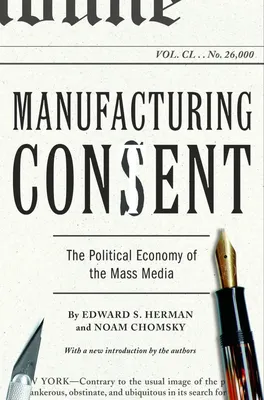
| Publisher | Random House |
| Published | 1994 |
| Pages | 434 |
| ISBN | 9780099533115 |
| Categories | Business & Economics |
What Readers Say
The word that comes up most when readers talk about Manufacturing Consent is "eye-opening." Not in the vague self-help sense — readers describe a specific shift in how they process news after reading it. One reader picked it up during the chaos of 2020 and said it gave them "a better understanding of how to pick out bullshit in the media." Several readers go further and call it required reading for high school students, which is a high bar for a 434-page media theory book from 1988.
What Chomsky and Herman built here isn't a conspiracy theory — it's a structural model. The "propaganda model" explains media behavior through ownership, advertising dependence, sourcing habits, and flak, and it gives you a framework for understanding why certain stories get covered the way they do. Readers consistently say the value isn't in agreeing with every conclusion but in having a lens that makes media behavior legible. Multiple readers describe it as a book that "changed my worldview significantly."
The honest caveat: Chomsky is polarizing in academia. Some scholars consider his media work popular rather than rigorous, and there's a fair criticism that the model can become a hammer that makes everything look like a nail. But among general readers, the book's influence is enormous — it's one of the most frequently recommended nonfiction books on Reddit, period.
Who It's For
Readers who want a structural explanation for media behavior rather than a conspiracy theory. If you've ever wondered why coverage of certain events feels coordinated without anyone explicitly coordinating it, this book offers the most widely read framework for answering that question. It's also the right starting point for anyone working through the propaganda reading list — Chomsky's model is the one everyone else is either building on or arguing against.
Reading Context
Manufacturing Consent sits at the center of a reading cluster that includes Amusing Ourselves to Death by Neil Postman (media as entertainment), The True Believer by Eric Hoffer (mass movement psychology), and The Shock Doctrine by Naomi Klein (disaster capitalism). Readers often recommend all four together. There's also a documentary companion film of the same name that condenses the argument for readers who want a preview before committing to the full text. For the deeper intellectual history behind Chomsky's critique, Walter Lippmann's Public Opinion is the foundational text he's responding to.