Book recommendations, reviews, and reading lists.

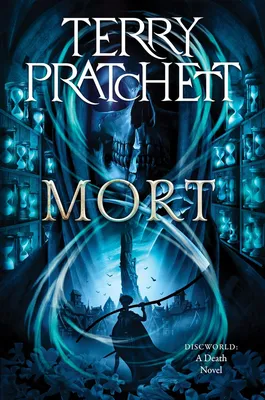
Mort
by Stephen Briggs, Terry Pratchett
| Publisher | Random House |
| Published | 2011-09-30 |
| Pages | 194 |
| ISBN | 9781446497852 |
| Categories | Fiction |
What Readers Say
The thing readers say most consistently about Mort is that Death is Pratchett's best character — and that's a real claim in a series with forty-odd books and dozens of memorable figures. He's a seven-foot skeleton who rides a white horse named Binky, is genuinely fond of cats, and takes on an apprentice because he's curious what it would feel like to take a holiday. That last detail is the one that gets people. Pratchett doesn't play Death as a joke or as a villain — he plays him as someone earnestly trying to understand humanity, which turns out to be funnier and stranger than either of those options.
What readers notice under the humor is that Mort operates on narrative logic rather than physics. Things happen on the Discworld because stories demand them, not because of cause and effect, and once you accept that framework, everything in the book clicks. Pratchett spells it out almost directly, and readers find it genuinely illuminating — not just as a fantasy premise, but as a way of thinking about how fiction works. The book is also cinematic in a way readers point to specifically: it plays out in the mind visually, moves fast, and doesn't slow down for more than a page or two at a stretch.
What surprises people most is that Mort keeps showing up in threads about death, terminal illness, and being in pain at 3am. That's not a coincidence. Pratchett wrote about mortality his entire career and brought something to it that's almost impossible to describe cleanly — the book is funny about death without being dismissive of it, warm without being saccharine, and sad in ways that don't announce themselves. Readers who pick it up expecting a comedy often find themselves doing something more complicated by the end.
Who It's For
Mort is the book I'd hand to anyone who's been meaning to try Pratchett but doesn't know where to start. The Discworld series has 41 novels and it's easy to feel like you need a roadmap — you don't, and this is the proof. It delivers everything that makes Pratchett worth reading (absurdist logic, genuine warmth, jokes that work on multiple levels) without requiring any prior context and without the rough edges of the earlier books.
It's also specifically good for readers who like humor that earns something rather than humor for its own sake. If The Hitchhiker's Guide to the Galaxy landed for you, Mort is the next logical move — both books are built on comic timing and absurdist premises, and readers who love one tend to immediately reach for the other. It works well for younger readers too, which comes up in the mentions — teens especially respond to Mort as a protagonist because he's earnest and awkward and genuinely trying, which is a combination Pratchett makes endearing without condescending.
Reading Context
Mort is the fourth Discworld novel but functions as a complete standalone — nothing carries over from the first three that you need. The near-universal Reddit consensus is to skip The Colour of Magic as a starting point; it's the weakest entry and the one most likely to put new readers off. Mort, Guards! Guards!, Small Gods, and Going Postal are the four names that come up again and again as the right places to begin, and any of them will work. Mort gets recommended slightly more often for readers who want something warmer and funnier; Small Gods for readers who want more substance upfront.
Within the series, Mort kicks off the Death subseries, which continues with Reaper Man, Soul Music, and Hogfather. Readers who love how Death is handled here tend to follow immediately with Reaper Man, which expands on the character significantly. Outside Discworld, Good Omens (Pratchett and Gaiman) comes up as the most natural companion read — the tone is similar, the warmth is similar, and if you're new to Pratchett it shows you what he sounds like in collaboration. The Hitchhiker's Guide is the other pairing readers reach for most, more for the structural comedy than the emotional register.