Book recommendations, reviews, and reading lists.

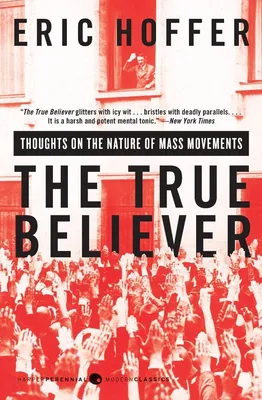
The True Believer
by Eric Hoffer
| Publisher | Harper Perennial Modern Classics |
| Published | 2026-10-27 |
| ISBN | 9780063566040 |
| Categories | History |
What Readers Say
The thing readers notice first about The True Believer is how short and dense it is. Almost every page has a sentence worth underlining, and Hoffer doesn't pad anything. He wrote this in 1951, working as a longshoreman on the San Francisco docks with no academic training, and that shows in the best possible way — there's no jargon, no hedge-betting, just direct compressed argument delivered with the confidence of someone who doesn't need tenure to say what he thinks.
His central insight is the one that sticks with people: the specific content of a mass movement matters less than the psychological need it fills. The true believer doesn't join because the ideology is correct. They join because the ideology gives them something — purpose, belonging, an escape from a self they can't stand. That reframing is what makes readers describe this book as "how cults are formed" and recommend it for understanding radicalization in any direction. It keeps showing up in threads about anti-intellectualism, propaganda, and political extremism because the framework applies regardless of which flag is being waved.
The criticism is that Hoffer's observations can feel aphoristic rather than argued — he's closer to a philosopher than a social scientist, and some of his claims deserve more evidence than he provides. But readers consistently say the trade-off is worth it. The book reads fast, hits hard, and stays in your head.
Who It's For
Anyone trying to understand how people become radicalized, regardless of which direction. This is the book I'd hand to someone watching a friend or family member get absorbed into a movement and thinking how did this happen? Hoffer's answer — that it's not about the ideas, it's about what the ideas do for the person — is uncomfortable and clarifying in equal measure.
Reading Context
The True Believer splits the difference between the accessible reads and the heavy ones on the propaganda shelf. It pairs naturally with Manufacturing Consent (Chomsky explains the structural machinery, Hoffer explains the psychological fuel) and with Arendt's The Origins of Totalitarianism (which covers similar territory with far more historical depth but at ten times the length). Readers who finish Hoffer and want something longer and more rigorous go to Arendt. Readers who want something more modern go to Pomerantsev's This Is Not Propaganda. Eisenhower cited this book on television, which made it a bestseller — a fact that's either ironic or fitting depending on how you read the argument.