Book recommendations, reviews, and reading lists.

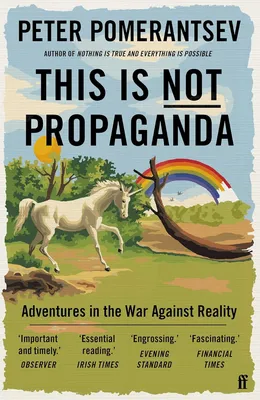
This Is Not Propaganda
by Peter Pomerantsev
| Publisher | PublicAffairs |
| Published | 2019-08-06 |
| Pages | 248 |
| ISBN | 9781541762138 |
| Categories | Political Science |
What Readers Say
Pomerantsev's core argument is one that reshapes how you think about propaganda entirely: the old playbook tried to make you believe one specific thing, but the new version tries to make you believe nothing at all. Flood the zone with noise until certainty itself becomes impossible. What makes this land so hard is the personal thread running through it. His parents were Ukrainian dissidents pursued by the KGB, and his own career has been spent watching that same authoritarian playbook get updated for the internet age. It's part memoir, part investigation, and the combination gives the whole thing a weight that a purely analytical book wouldn't have.
Readers consistently describe both this and his earlier book Nothing Is True and Everything Is Possible as genuinely well-written, which matters in a genre where a lot of titles read like extended policy papers. Pomerantsev writes like a journalist who actually cares about sentences. The book sits comfortably alongside heavier hitters like Manufacturing Consent and The Origins of Totalitarianism on propaganda reading lists, but it's more accessible than either of those — a good entry point if you want to understand modern disinformation specifically rather than the full historical arc.
Who It's For
If you've been following the erosion of shared reality over the last decade and want something that explains the mechanics behind it, this is the book I'd point you toward. It's especially useful if you've already read something like Postman's Amusing Ourselves to Death and want to see how those media-structure critiques apply to the current disinformation landscape. At 248 pages, it doesn't overstay its welcome.
I'd also recommend it to anyone interested in Russia and information warfare who wants something more personal and narrative-driven than the typical policy analysis. Pomerantsev lived this material — he didn't just study it from the outside.
Reading Context
The natural companion read is Pomerantsev's earlier book Nothing Is True and Everything Is Possible, which covers his time working in Russian television. Together they form a two-part look at how propaganda operates from the inside out. If you're building a broader reading list on propaganda and persuasion, I'd suggest starting with Cialdini's Influence for the basic mechanics, then moving to either Postman for media structure or Pomerantsev for modern disinformation — depending on which angle interests you more.