Book recommendations, reviews, and reading lists.

The Remains of the Day
by Kazuo Ishiguro
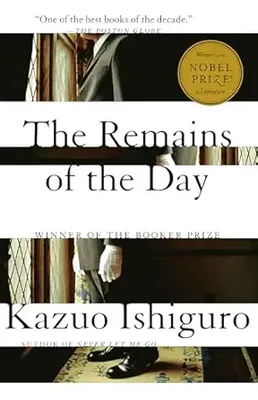
| Publisher | Faber & Faber |
| Published | 2009-01-08 |
| Pages | 233 |
| ISBN | 9780571249350 |
| Categories | Fiction |
What Readers Say
What consistently floors me about this book is how it sneaks up on you. Readers talk about being completely unprepared for a story about an aging butler to grab them by the throat — one person called it a "freight train that I didn't see coming." The prose is restrained and gorgeous, but the emotional devastation builds so quietly that you don't realize you're being gutted until it's too late. Multiple readers mention finishing it and suddenly finding themselves crying without quite knowing when it started.
The tone of resignation is what really sticks with people. This isn't a tragedy in the traditional sense — nobody dies dramatically, no single catastrophic event unfolds. Instead, it's a slow-burn meditation on a life of emotional repression and missed opportunities, and that's what makes it so haunting. Readers consistently describe it as "not sad in the moment" but deeply, almost unbearably sad when you sit with it afterward. The existential weight comes from watching Stevens rationalize his choices and deny his own feelings, and Ishiguro handles this with such precision that the restraint itself becomes the heartbreak.
The book also gets cited repeatedly alongside Never Let Me Go as the best entry point to Ishiguro's work, though several readers who bounced off that novel say The Remains of the Day was a completely different experience — far more emotionally accessible. It shows up on lists of beautifully written books, books that make you cry, and favorite books of the year, often with the kind of passionate loyalty that suggests it genuinely changed how people think about fiction.
Who It's For
This is for readers who want existential depth delivered without a sledgehammer. If you loved the quiet devastation of Atonement by Ian McEwan or the controlled emotional repression in On Chesil Beach, you'll find similar terrain here. It's also for anyone who appreciates prose that's beautiful without being showy — Ishiguro's style is deceptively simple but carries enormous weight, and readers who value that restraint over verbal pyrotechnics will be in heaven.
If you're someone who finds meaning in stories about people who can't say what they feel — or who realize too late what they've sacrificed — this book will absolutely wreck you. One reader compared it to the pervasive loneliness in Teddy Wayne's Apartment, and I think that tracks: it's for people drawn to characters whose dignity doubles as a cage. It's not for readers who need plot-driven momentum or obvious emotional payoff. The rewards here are cumulative, quiet, and all the more powerful for how they creep in sideways.
Reading Context
Most readers pair this with Ishiguro's other work — Never Let Me Go is the obvious companion, and several people mention An Artist of the Floating World as a thematic sibling since both deal with characters confronting their complicity in larger cultural systems they served. Outside Ishiguro, it gets mentioned alongside Stoner by John Williams and Atonement, books that share its focus on a single life's weight and the ache of choices made or avoided.
There's a 1993 film adaptation with Anthony Hopkins and Emma Thompson that's deeply faithful to the novel's tone, though most readers say to experience the book first for the full effect of Ishiguro's narrative voice. The novel won the Booker Prize in 1989 and was a key factor in Ishiguro's 2017 Nobel Prize win — one commenter noted that it exemplifies the kind of reflective, legacy-examining work the Nobel committee has always valued. Fair warning: don't expect catharsis. What you get instead is something quieter and stickier, the kind of sadness that settles into your bones and stays there.